Monday, December 21, 2009
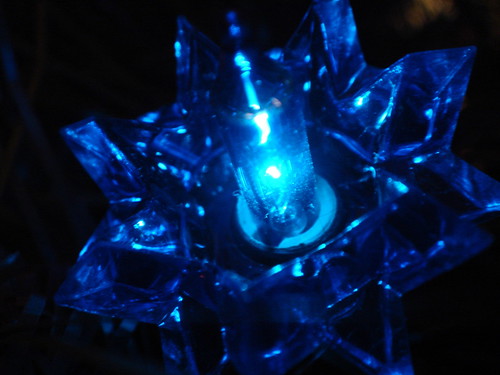
Glad Jul! This set of Christmas lights purchased last year at Target remind me of an old imported Italian light set my family had when I was a child. Those Italian lights had a set of three concentric colored plastic "crowns" that reflected and transmitted the colored light from the bulb in a magical fashion. I used to stare into the tree and unfocus my eyes, watching the lights' myriad colors coruscate across the tinsel and ornaments like a kaleidoscope. We used that set of lights for over ten years, until several bulbs burned out and the electric current running through the remaining ones increased to the point it overheated the others, causing some of plastic "crowns" to melt over the bulbs. Not the safest design, but they were the most beautiful Christmas lights I've ever seen. I'm pretty certain that 1970 set was not UL Listed (ha!) but they were still a sight safer than the actual wax Christmas tree candles my parents and grandparents used to have on their (natural) trees when they were kids.
Both of them have hair-raising stories of trees that caught fire and threatened to burn down the family home, if not for a quick-thinking relative that doused the burning branches with water or tossed the flaming tree out the door into the snow. Those were the good old days...
Friday, June 22, 2007
What happens when you crash a BMW into a Volvo head-on while both vehicles are traveling at 60mph?
As the announcer says: "...next time you're on a country road, counter-flow or about to overtake - remember this."
Labels: safety, science, transit, video
Monday, June 11, 2007
 Chicago's subway and train lore are filled with tales of people electrocuted or severely injured as a result of touching the live "third rail" that supplies power to the trains. What's puzzling is the city's (and the CTA's) frequent contention that this is an inescapable fact of life (or acceptable risk) with 'third-rail'-powered public transit.
 I don't believe that's exactly true. I snapped this photo of the Metro train tracks in Washington, DC, which shows a simple way the third rail can be made safer - the top of the third rail is covered with a firm insulating canopy at stations (not along its entire length) to prevent most accidental contact with the high-voltage rail. So why hasn't the CTA implemented a system like this? For one, this safety feature does require a mechanical change to the train - the third rail shoe needs to be side-contacting, not vertically-contacting, as is the case with existing Chicago 'L' trains; and granted, changing the third-rail shoes on all CTA trains and installing insulating covers above the hot rail at stations would be fairly costly. But besides the covers over the third rail Washington uses, the rail itself is almost identical* to that used by the CTA. Wouldn't it be worth the price in lives saved and reduction of liability/injury settlement costs?
Perhaps not; the cynical part of me suspects the city might rather occasionally throw some money at injured plaintiff families than invest in a system-wide safety improvement on aging transit infrastructure that is increasingly costly to maintain. Not to mention that with the CTA once again threatening "doomsday" service cuts, investment in new safety equipment is probably the last item on the agenda. On the other hand, with Chicago gunning for Olympic City status, is upgrading our public transportation system to modern safety standards currently available in other major U.S. cities really too much to ask?
* DC's Metro third rail voltage is nominally 750V, Chicago's CTA uses 600VDC.
More: The case of Eshoo v. CTA (1999), Illinois Appellate Court docket No. 1-97-1138. Also Lee v. CTA (1992) CBS-2 Chicago carried a feature on the third-rail hazard in May 2005, video available at their site.
Labels: chicago, law, safety, transit
Sunday, January 21, 2007
If you think all the hazardous radioactive material being transported across the country is safeguarded - or at least properly packaged and prepared for shipment on public thorofares - think again. The circumstances of last Tuesday's truck crash near the Mojave National Preserve are truly frightening if they're any indication of how carelessly lethal materials like plutonium might be traveling, perhaps in a vehicle rolling alongside you. From the San Bernadino Sun:Baking soda, bunk beds, fire extinguishers - and a drum with plutonium-238. The truck that crashed Tuesday near Needles [CA] with a load of radioactive waste was a plain old commercial truck carrying plain old products.
When emergency workers checked the truck's manifest they were surprised that radioactive material was being shipped with ordinary goods. "This, in and of itself, is very alarming," said San Bernardino County Fire Marshal Peter Brierty, who also directs his agency's hazardous materials unit. Government and industry officials say shipping radioactive materials by commercial carriers is a perfectly safe, perfectly routine practice. The containers, the routes and the shipping companies are all heavily regulated, and there has never been an accident that resulted in a release of radiation, they said.
The radiation emitted by the truck's amount of plutonium-238 is trillions of times more than is allowed in drinking water, Brierty said. The four grams of plutonium involved in the crash would be roughly the volume of a pencil eraser. But that amount kicks out more than 60 curies, a measure of radioactivity. In contrast, the drinking water standard is 15 picocuries per liter, or 15 trillionths of one curie.
...
The truck, pulling two trailers, crashed into a guardrail on eastbound Interstate 40, rupturing the tractor's fuel tank and causing the rear trailer to overturn and split open. The driver was unhurt. Part of the freeway was shut down for 18 hours. The heavily shielded, 500-pound, 55-gallon drum with the plutonium was in the front of the damaged trailer, California Highway Patrol Officer Michael Callahan said. The entire cargo had to be unloaded to get at the drum.
The drum was undamaged, and there was no leakage of radiation. [But,] "What the hell is that doing in that truck?" said Robert Halstead, an expert in the transportation of nuclear waste. [read full article]


 Blue, Blue Christmas Lights


