Wednesday, November 25, 2009
If only a photo could convey the sharp, evocative scent of burning brush in Willow Springs Woods (FPDCC.gov Region 6 - Palos Division) last week; a perfect fall day in the southwest suburbs.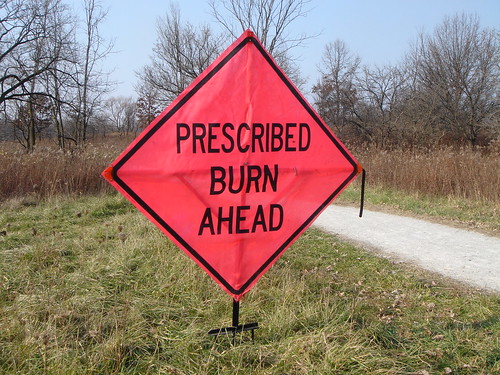
Traveling a bit further west on Archer Avenue to the Red Gate Woods forest preserve area, we found this old mossy stone wall or foundation, partially buried under what could be a century or two of accumulated soil and undergrowth.

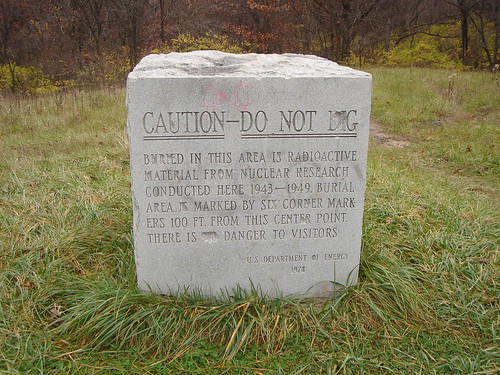
Who lived here in the woods along Illinois' most haunted highway? Early Polish or Irish immigrants who built the roads and canals along this ancient native American trail? We do know what's buried here today in Red Gate Woods: the remains of CP-1, the first sustained nuclear "reactor" built by Enrico Fermi at the University of Chicago.
Labels: chicago, history, nuclear, photo
Wednesday, September 05, 2007
Any of you Midwestern folks out there have a funny feeling last week? You know, that something might have fallen out of the sky? Nope, no reason. Just askin'. From WIRED News:This reminds me of an apocryphal story/urban legend I once heard regarding a nuclear near-catastrophe that supposedly occurred at Plattsburgh Air (NY) Force Base - once a strategic missile site - in the late 1980's, where a technician accidentally armed an ICBM warhead during routine maintenance. Allegedly, the error was discovered and corrected only minutes before the warhead was set to detonate.WASHINGTON (AP) -- A B-52 bomber was mistakenly armed with six nuclear warheads and flown for more than three hours across several states last week, prompting an Air Force investigation and the firing of one commander, Pentagon officials said Wednesday. The incident was so serious that President Bush and Defense Secretary Robert Gates were quickly informed and Gates has asked for daily briefings on the Air Force probe, said Defense Department press secretary Geoff Morrell. He said, "At no time was the public in danger."
Rep. Ike Skelton, chairman of the House Armed Services Committee, called the mishandling of the weapons "deeply disturbing" and said the committee would press the military for details. Rep. Edward J. Markey, a senior member of the Homeland Security committee, said it was "absolutely inexcusable. Nothing like this has ever been reported before and we have been assured for decades that it was impossible." ...
The plane was carrying Advanced Cruise Missiles from Minot Air Force Base, N.D, to Barksdale Air Force Base, La., on Aug. 30, said the officials, who spoke on condition of anonymity because of a Defense Department policy not to confirm information on nuclear weapons. The missiles, which are being decommissioned, were mounted onto pylons on the bomber's wings and it is unclear why the warheads had not been removed beforehand.

I haven't found any independent evidence to corroborate the story, but it still gives me the willies to think what might have happened: at the time was living in Plattsburgh, barely a mile from the facility.
Labels: nuclear
Wednesday, April 25, 2007
 I was eighteen when Chernobyl exploded. In retrospect, I realize it was one of the first times I really followed the news outside my adolescent self-absorption. The reporters' accounts of the poison fire that could not be extinguished for days on end seemed nearly supernatural - what had been unleashed there? Could the fire be extinguished?
This disaster was innocence lost - on both a personal and global scale. The local CBC television news affiliate showed Soviet helicopters futilely dumping payloads of borax and lead, attempting to quell the roaring graphite core to little avail. One copter's rotor blades came too close, and the machine crashed into the power plant, killing its pilot.
It was like fighting Godzilla, but this was no movie.
Eventually, someone proposed a last-ditch attempt to flow liquid nitrogen under the reactor floor to cool the relentless corium flow that threatened to reach bedrock aquifers. If the blazing lava flow of molten reactor fuel, concrete and metal reached it, when the intense heat split groundwater molecules into elemental hydrogen and oxygen a massive explosion far surpassing the original reactor failure would have been the result. Thankfully, the corium eventually cooled.
Researchers were detecting traces of fallout across the Northern U.S. as atmospheric movements spread the reactors' plume: it seeemed no place was truly safe. Later I would realize there was nothing supernatural about the event - it was simply man's hubris, laxity, and lack of healthy respect for the power of nature that allowed Chernobyl to happen.
At 1:23AM on April 26th, 1986:
"My friends were dying under my eyes," said Konstantyn Sokolov, 68, a former Chernobyl worker whose voice was hoarse from throat and lip cancer. "I try not to recollect my memories. They are very terrible." Mykola Malyshev, 66, was working in the control room of Chernobyl's Reactor No. 1 at the time of the explosion. He said the lights flickered and the room shook. The workers were ordered to the destroyed reactor, but when they got there, their co-workers ordered them to flee and save themselves. "They told us, 'We are already dead. Go away,"' Malyshev recalled at the Kiev ceremony.A highly recommended book: Voices From Chernobyl by Svetlana Alexievich, published last year shortly before the 20th anniversary of the disaster; the work chronicles the experiences of Prip'yat refugees and the horrifying experiences of the "liquidators"' loved ones, who saw first-hand the effects of searing radioactive fire on frail human flesh. Its most haunting quality is the raw pain and hope expressed by the friends and family of these first responders, many of whom suffered unspeakable deaths days, weeks, and months after the tragedy. See Radioactive! The Nuclear Blog for my annual Chernobyl memoriam.
In Slavutych, a town built to house displaced Chernobyl workers, commemorations began an hour earlier to coincide with Moscow time, which was used in the Soviet era. Residents laid flowers and placed candles at a monument as sirens blared. The explosion tore off the plant's roof, spewing radioactive fallout for 10 days over 77,220 square miles of the then-Soviet Union and Europe. At least 31 people died as a direct result of trying to keep the fire from spreading to the plant's three other reactors. One plant worker was killed instantly and his body never recovered.
Twenty-nine rescuers, firefighters and plant workers died later from radiation poisoning and burns, and another person died of an apparent heart attack.
Death tolls connected to the blast remain hotly debated, as do the long-term health effects. [from CBS2 Chicago, April 26, 2006]
As our fossil fuels drain and we restoke our nuclear furnaces to feed our hunger, let us never forget this Promethean lesson. Respect the atom: like fire, it feeds but also kills.
Sunday, January 21, 2007
If you think all the hazardous radioactive material being transported across the country is safeguarded - or at least properly packaged and prepared for shipment on public thorofares - think again. The circumstances of last Tuesday's truck crash near the Mojave National Preserve are truly frightening if they're any indication of how carelessly lethal materials like plutonium might be traveling, perhaps in a vehicle rolling alongside you. From the San Bernadino Sun:Baking soda, bunk beds, fire extinguishers - and a drum with plutonium-238. The truck that crashed Tuesday near Needles [CA] with a load of radioactive waste was a plain old commercial truck carrying plain old products.
When emergency workers checked the truck's manifest they were surprised that radioactive material was being shipped with ordinary goods. "This, in and of itself, is very alarming," said San Bernardino County Fire Marshal Peter Brierty, who also directs his agency's hazardous materials unit. Government and industry officials say shipping radioactive materials by commercial carriers is a perfectly safe, perfectly routine practice. The containers, the routes and the shipping companies are all heavily regulated, and there has never been an accident that resulted in a release of radiation, they said.
The radiation emitted by the truck's amount of plutonium-238 is trillions of times more than is allowed in drinking water, Brierty said. The four grams of plutonium involved in the crash would be roughly the volume of a pencil eraser. But that amount kicks out more than 60 curies, a measure of radioactivity. In contrast, the drinking water standard is 15 picocuries per liter, or 15 trillionths of one curie.
...
The truck, pulling two trailers, crashed into a guardrail on eastbound Interstate 40, rupturing the tractor's fuel tank and causing the rear trailer to overturn and split open. The driver was unhurt. Part of the freeway was shut down for 18 hours. The heavily shielded, 500-pound, 55-gallon drum with the plutonium was in the front of the damaged trailer, California Highway Patrol Officer Michael Callahan said. The entire cargo had to be unloaded to get at the drum.
The drum was undamaged, and there was no leakage of radiation. [But,] "What the hell is that doing in that truck?" said Robert Halstead, an expert in the transportation of nuclear waste. [read full article]


 Prescribed Burn Ahead in Willow Springs Woods


